
How This Year's Convocations Led to the Corrington Award
Written by Lillian Loggins '30
2026 Corrington Award · Monday, October 26, 6:30–8:00 p.m. · Marjorie Lyons Playhouse
Before an author takes the stage to accept the Corrington Award, students usually have a chance to approach the work from several directions. This year, that preparation came in the form of three convocations, each led by a faculty member from a different discipline, each circling the same set of questions: How do we remember? What do we do with the past? What are things made of, and what can that tell us about ourselves? On Monday, October 26, from 6:30 to 8:00 p.m., those questions come together at Marjorie Lyons Playhouse, where the 2026 Corrington Award will be presented to Richie Hoffman, author of The Bronze Arms, a collection of Hoffman's works.
What is a Convocation?
A convocation is a gathering of the campus community around a shared idea. Unlike a standard class lecture, a convocation isn't tied to a single course or major. Students from any field are invited to attend, listen, and think alongside faculty. This fall's series was designed as a lead-up to the Corrington Award, giving students a way to enter the conversation about Hoffman's work before the author arrives.
Convocation One: The Stories We Tell About Ourselves
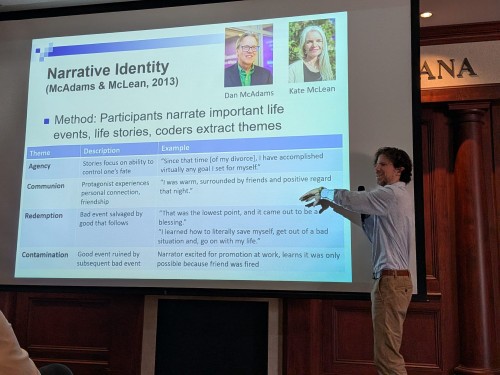
The series opened with "Narrating the Self: Stories We Tell Ourselves About Ourselves, and Why They Matter," presented by Dr. Pete Zunick, associate professor of psychology. Zunick took a psychological approach, focusing on memory and myth. His central point was an unsettling one: the way we recall an event is often different from what actually happened. Memory isn't a recording. It's a reconstruction, shaped by who we are now, what we need to believe, and the stories we have built to make sense of our lives.
That idea set the tone for everything that followed. If our personal histories are partly stories we have authored, then storytelling isn't just something that happens in books. It's something each of us does constantly.
Convocation Two: How Art and Myth Survive
The second convocation, "Recasting the Past: How Art and Myth Survive," was presented by Dr. Kyra Rietveld, assistant professor of art history. Rietveld widened the lens from individual memory to collective memory. She discussed myth and historical artwork, and how people in later eras can perceive a work very differently than its creators intended.
An object or image can outlive its original purpose, and each generation reads it anew. Meaning, in other words, isn't fixed at the moment of creation. It is renegotiated over time. For students, the takeaway was that the past is something we continually reinterpret, whether we're looking at a monument, a painting, or a family story.
Convocation Three: The Matter of Bronze
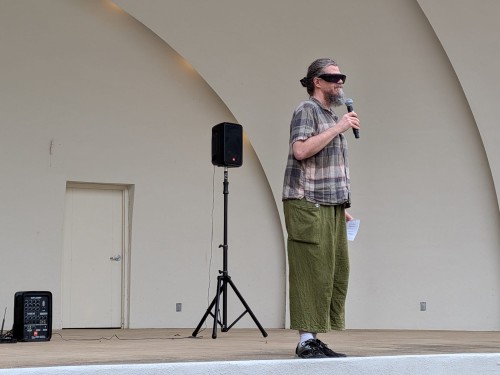
The final convocation turned from memory and meaning to material. In "Bronze: A Story of Matter and What It Might Tell Us About Ourselves," Dr. Joshua Lawrence, associate professor of chemistry, discussed the physical properties of bronze and copper. His aim was to illuminate the poetry of the work through the physical world, offering a more tangible way of understanding what bronze is and why it has carried such weight in human history.
Bronze is an alloy, a combination of metals that produces something different from its parts. It's a material tied to tools, weapons, sculpture, and ritual, which makes it a natural bridge between the scientific and the symbolic.
Lawrence's talk gave students a grounded, almost tactile way into the title image at the heart of Hoffman's collection.
How the series builds
Taken together, the three convocations form a kind ofan arc. Zunick asked how individuals build stories about themselves. Rietveld asked how cultures preserve, distort, and reinterpret their stories. Lawrence asked what the physical stuff of the world, in this case bronze, can reveal about us. Psychology, art history, and chemistry arrived at overlapping territory: memory, myth, and the objects we use to hold onto both.
Students who attended all three will come to the Corrington Award with a layered set of lenses for approaching The Bronze Arms. Those who didn't will still find that the questions are accessible to anyone who has ever wondered why a memory feels different the second time around.
The 2026 Corrington Award
The Corrington Award ceremony will honor Richie Hoffman for The Bronze Arms on Monday, October 26, from 6:30 to 8:00 p.m. at Marjorie Lyons Playhouse on campus. It is a chance to hear from the author directly and to see how the questions raised this fall play out in Hoffman's work. Students, faculty, and community members are encouraged to attend.