
100% of Centenary psychology majors complete an original research project, not a hypothetical exercise, but real data collection, analysis, and presentation. It's a major factor in graduate admissions, and students here get that experience three ways:
- In coursework. Research Methods, Psychology of Design, Brain & Language, Senior Seminar, and other classes have you design a study, collect data, run the analysis, and present your findings — a complete project in a single semester.
- Alongside faculty. Ongoing faculty research projects have openings for student collaborators, who help plan studies, collect data, run statistical analyses, and prepare posters and papers.
- Through an Honors Thesis. Students who want to go deeper design their own independent project starting junior year — writing a literature review, collecting original data, and producing a senior thesis.
We also foster a culture of excellence in research, preparing students for graduate study through organizations and activities including:
- Psi Chi: International Honor Society in Psychology. Top-performing majors — the top 35% of the class — are invited to join Psi Chi, the international honor society in psychology. It's a distinction graduate programs recognize, and it connects you with a community of high-achieving peers across the country.
- Journal Club. About once a month, students and faculty sit down together to discuss a current article from the psychology research literature — an easy, low-pressure way to build critical reading skills and get to know faculty outside of class.
Our students' research has been presented at national conferences including the Society for Personality and Social Psychology and the Psychonomic Society. We also co-host the annual Centenary Research Conference where psychology students present annually. Students can also apply for funding to earn a stipend for completing summer research.
Faculty Research
Dr. Alexander is currently engaged in speech perception projects examining perceptual learning and memory for accented speech, acoustical analyses and perceptual ratings of vocal fry, and acoustical correlates of intelligibility and accentedness in English across first-language groups. She's also interested in the role of auditory imagery in reading, sound symbolism and cross-modal mappings of speech sounds, and how the sounds of language interact with the communicative message.
Dr. Hammond is researching the cognitive and emotional development of college-age populations, especially in relation to the college environment. Her current projects examine how immersive experiences (like May intercultural immersion classes) affect student development, how students benefit from class-related experiences and service-learning, and how development relates to academic dishonesty.
Dr. Zunick conducts research at the intersection of prejudice, attitudes, and identity. His current projects investigate how diversifying learning materials can help students of color feel more belonging in STEM settings, how people's beliefs about gender influence their visual imagery of transgender individuals, and how one's identity and other attitudinal factors shape how one reacts to prejudiced comments.
Recent Student Projects
Julianna Malloy ‘26— Investigated whether diverse anatomical models improve belonging and motivation for Black students in Biology classrooms.
For her Honor's Thesis, Julianna investigated the effects of Black skin-tone anatomical models as identity-safety cues for students of color in Biology classrooms, testing whether these more diverse models influence Black students' belonging, self-efficacy, motivation, and other related variables. Julianna and Dr. Zunick received a student-faculty research award, which supported her work over the summer and helped fund online data collection. She presented her work at the annual campus-wide Research Conference as well as the Society for Personality and Social Psychology's annual convention in Chicago.
Mackenzie Olinger '25 — Tested whether adults can learn to better understand toddler speech.
Can we get better at understanding very young children? Mackenzie used a database of speech from 2- and 3-year-olds to train listeners, finding some evidence of learning to better understand 3-year-olds — though that learning didn't generalize to new kids. Mackenzie presented her research at Centenary's on-campus Research Conference in April 2025, and Dr. Alexander presented the work at the 2025 annual meeting of the Psychonomic Society in Denver. Mackenzie is working toward becoming a Speech-Language Pathologist.
Gracie Napier '24 — Replicated a 2014 study on how "vocal fry" affects listener perceptions of men's and women's speech to see if we've changed how we judge them for it.
Gracie worked in the psychology department for multiple years, starting in a one-credit research class helping faculty with research tasks. She then designed her own Honor's Thesis, a replication and extension of a 2014 study on vocal fry's impact on speech perception. Gracie and Dr. Alexander received a student-faculty research grant and collected data from 600 participants. Gracie presented her work at the annual campus Research Conference.
Mackenzie Williams '24 — Studied how memory is disrupted by sentences that violate gender stereotypes.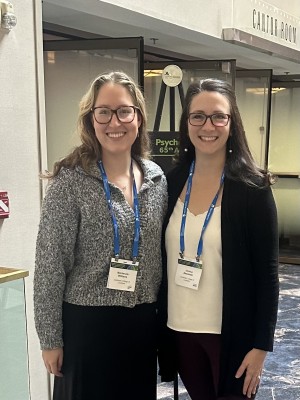 For her Honor's Thesis, Mackenzie designed a replication and extension of a study on how memory is disrupted by final-word violations in sentences (e.g., "We brought a tent to go bacon."). She investigated whether words that violated gender stereotypes showed the same kind of memory disruption as semantic violations, and found a disconnect between processing of semantic and pragmatic violations. Mackenzie presented her research at the 2024 on-campus Research Conference, and Dr. Alexander presented it at the 2024 annual meeting of the Psychonomic Society in New York. Mackenzie is continuing her research into the psychology and neuroscience of memory as a graduate student at LSU in Baton Rouge.
Mallarie Mixon ‘22 — Found that people are more likely to confront racist or sexist remarks when their attitudes are tied to their self-identity.
Mallarie's Honor's Thesis investigated attitudinal factors predicting whether bystanders confront prejudiced remarks, focusing on the extent to which participants' race and gender attitudes were self-defining — connected to their identity and sense of self. Her results confirmed her hypothesis: the more participants' attitudes were tied to their sense of self, the more likely they were to report intending to confront the speaker. Mallarie presented her work at the Centenary Research Conference, and Dr. Zunick presented it at the 2023 meeting of the Society for Personality and Social Psychology in Atlanta.